Breathe Easy on the Road: Essential Accessories for In-Car Air Quality & Allergen Reduction
Let’s be honest. We spend a lot of time in our cars. It’s a commute, a road-trip vehicle, a mobile office, and sometimes, a snack bar on wheels. But have you ever stopped to think about what you’re breathing in there? That “new car smell” fading often reveals a cocktail of cabin air that’s, well, less than fresh.
From pollen and dust to pet dander and even off-gassing from plastics, your car’s interior can be a hotspot for allergens and pollutants. The good news? You don’t have to just roll down the window and hope for the best. A new wave of clever accessories can transform your cabin into a sanctuary of clean air. Let’s dive into the gear that lets you breathe easier, mile after mile.
The Unseen Problem: What’s Really in Your Car’s Air?
Before we get to the solutions, it helps to know what we’re up against. Think of your car as a small, sealed box hurtling down the road. It pulls in air from outside—air that contains exhaust fumes, pollen, and road dust. Inside, you add your own ingredients: fibers from upholstery, crumbs, skin cells, and moisture. It’s a perfect recipe for poor air quality.
For allergy sufferers, this mix is a nightmare. A standard cabin air filter helps, sure, but it’s often the bare minimum. To truly enhance in-car air quality, you need a multi-layered approach. That’s where these accessories come in.
Your First Line of Defense: Upgraded Cabin Air Filters
This is the simplest, most effective upgrade you can make. Swapping out your standard paper filter for a high-performance one is like giving your car’s lungs a major upgrade. Here’s what to look for:
- HEPA-Filtration Cabin Air Filters: These are the gold standard. True HEPA filters can trap at least 99.97% of particles as small as 0.3 microns. That includes most allergens, mold spores, and fine dust. Not all cars can physically fit a true HEPA, but many “HEPA-style” or “allergen” filters offer a massive improvement.
- Activated Carbon Filters: These are fantastic for tackling odors and gaseous pollutants. That smell of diesel exhaust or the fumes in a traffic jam? Activated charcoal absorbs and neutralizes them. Many of the best filters combine a particle layer with a carbon layer for broad-spectrum protection.
Pro Tip: Check your vehicle’s manual and replace this filter at least once a year, or more often if you drive in dusty or high-pollution areas. It’s a 10-minute, low-cost fix with a high-impact payoff for allergen reduction.
Powerful Add-Ons: Portable Car Air Purifiers
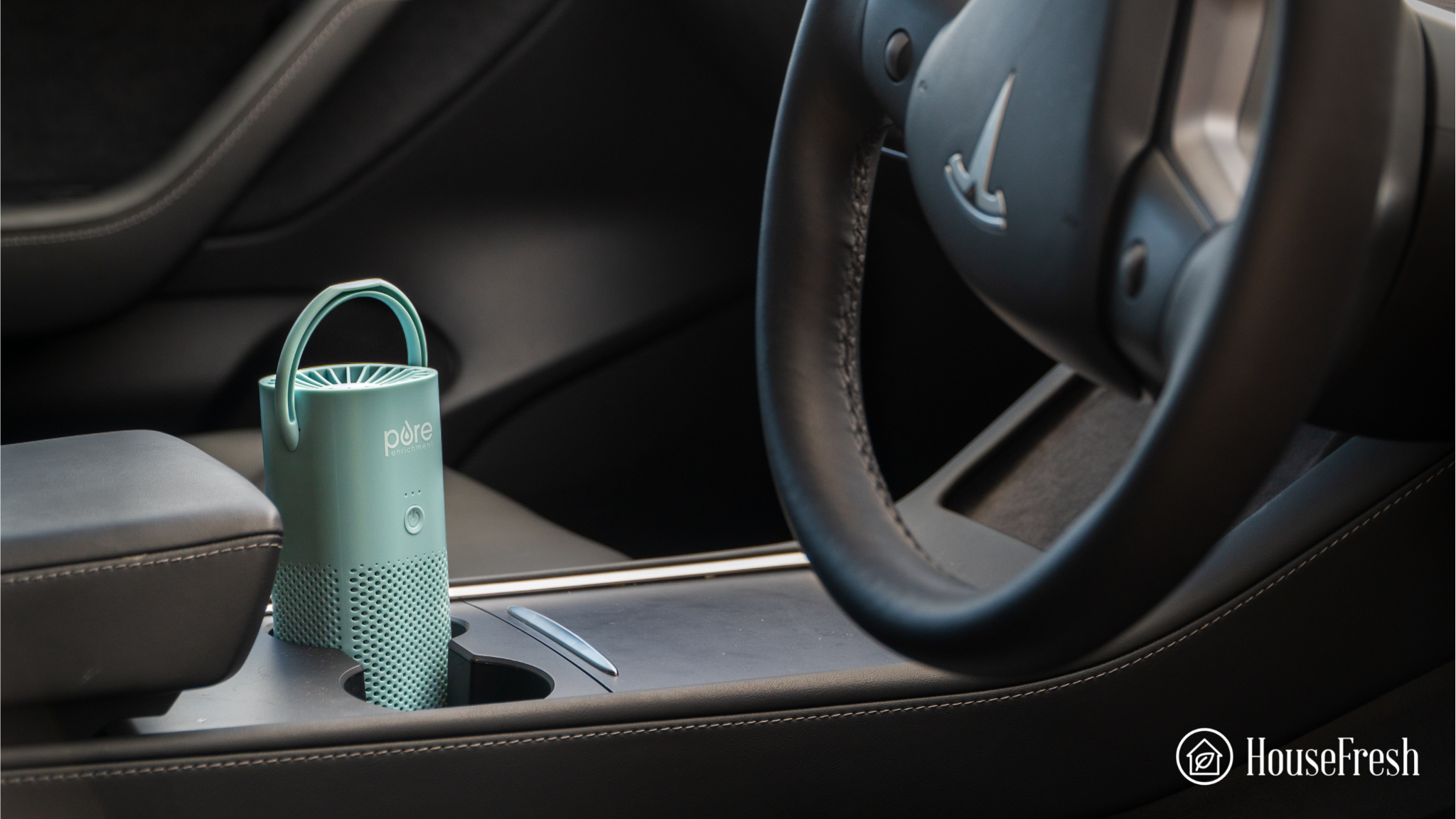
If a better filter is like upgrading your lungs, adding a portable air purifier is like hiring a dedicated cleaning crew for your cabin air. These plug into your 12V socket (or sometimes USB) and work independently of your car’s own system.
They’re ideal for a few scenarios: older cars with weak ventilation, rideshares where you can’t control the main filter, or for giving an extra boost during peak allergy season. Key features to consider include:
| Feature | Why It Matters |
| HEPA Filter Inside | Captures microscopic allergens and particles. |
| Ionizer / Negative Ion Generator | Helps clump particles so they fall out of the air or are easier for the filter to catch. (Note: Some models produce trace ozone, so look for ozone-free certifications if sensitive). |
| UV-C Light | Uses short-wave ultraviolet light to neutralize bacteria, viruses, and mold spores at the cellular level. |
| Quiet Operation | You don’t want a noisy distraction on a long drive. |
A Quick Note on Ionizers and Ozone
Some purifiers use ionizers. While effective, a few can generate ozone, which itself is a lung irritant. If you or a passenger have asthma or are sensitive, look for devices certified as ozone-free. It’s a small detail that makes a big difference in safety.
Beyond the Air: Proactive Allergen Reduction Tools
Clean air is one thing. But stopping allergens at the door? That’s next-level. These accessories tackle the problem at its source.
- All-Weather Floor Mats (and Liners): This might seem unrelated, but hear me out. Cloth carpets trap pollen, dirt, and dander. High-quality rubber or thermoplastic liners (like WeatherTech or Tuxmat) create a seamless, waterproof barrier. You can literally pull them out, hose them off, and eliminate a huge reservoir of allergens. It’s a game-changer.
- Seat Covers for Pet Owners: Specially designed, waterproof pet seat covers create a dedicated, washable zone for your furry friend. This contains pet dander and hair, preventing it from embedding itself deep into your upholstery where it constantly re-circulates.
- Microfiber Dash & Console Dusters: Static charge on your dashboard and screens actually attracts dust like a magnet. Keeping a small, damp-style microfiber cloth in your glovebox lets you quickly wipe down these surfaces, preventing that dust from becoming airborne every time you hit a bump.
The Low-Tech, High-Impact Essentials
Not every solution needs a plug. Sometimes, the simplest habits and tools are the most effective for maintaining a healthy cabin environment.
- Vent Clips with Essential Oils: Okay, these don’t “purify” in the technical sense. But a clip with a drop of eucalyptus or tea tree oil on the filter can provide a refreshing, natural scent that many find helps clear sinus passages. It’s a sensory boost, not a filtration one, but it contributes to the feeling of clean air.
- Regular Vacuuming (with the right tool): A handheld car vacuum with a HEPA filter bag or canister is crucial. You know that cloud of dust you see when you vacuum your seats? With a standard vacuum, you’re just blowing the finer particles back into the air. A HEPA-sealed model traps them for good.
- Sun and Ventilation: Never underestimate the power of the sun. On a hot, dry day, rolling up the windows and letting the car bake can help reduce moisture and inhibit mold growth. Follow it up by opening all doors and airing it out. It’s free, and it works.
Creating Your Clean Air Cockpit
So, where do you start? Honestly, you don’t need all of this at once. Think of it as a system. Start with the foundation: a high-quality cabin air filter. That’s your non-negotiable. From there, assess your needs.
Bad allergies or a long commute in traffic? Maybe add a portable HEPA purifier. Have kids or pets? Floor liners and seat covers will be your best friends for allergen reduction. The goal is to build layers of defense, creating a cleaner bubble within the often-polluted world outside your windows.
In the end, your car is a personal space. It should feel like a refuge, not a trigger. By taking a few thoughtful steps to enhance your in-car air quality, you’re not just protecting your health—you’re making every journey, whether a quick errand or a cross-country adventure, noticeably more pleasant. You’ll arrive feeling just a little bit fresher, a little bit clearer. And really, isn’t that the point?